
Artificial intelligence is transforming how videos are produced.
Just a few years ago, creating a professional video required cameras, editing software, voice actors, and hours of post production work. Today, many creators generate entire videos from a simple text prompt.
This shift is powered by the best ai video creation tools. These platforms allow creators, marketers, and businesses to produce engaging video content in minutes instead of days.
Whether you want to build YouTube videos, social media clips, marketing campaigns, or educational content, AI video tools can simplify the entire workflow.
In this guide, you will learn what AI video creation tools are, how they work, and which platforms are leading the space right now. You will also discover practical tips to help you choose the right tool for your content strategy.
What Are AI Video Creation Tools?
AI video creation tools are platforms that use artificial intelligence to generate, edit, or enhance video content automatically.
Instead of filming footage manually, users can provide inputs such as text prompts, scripts, images, or existing videos. The AI then converts those inputs into a complete video.
Many modern systems rely on generative AI models that analyze patterns from large video datasets to simulate motion, scenes, and visual storytelling. Some advanced models can even generate realistic audio and dialogue alongside the video.
AI video tools typically support features such as
Text to video generation
Image to video animation
AI avatars and presenters
Automated editing and transitions
Voiceover generation
Subtitle and caption creation
The result is a streamlined production process that lowers the barrier for anyone who wants to create video content.
Why AI Video Tools Are Becoming Essential for Creators
Video has become one of the most powerful formats for communication online.
Businesses rely on video for marketing campaigns, creators use it for social media growth, and educators use it for digital learning experiences.
However, traditional video production can be expensive and time consuming.
This is where the best ai video creation tools provide a significant advantage.
First, they reduce production time. A video that previously required hours of editing can now be generated in minutes.
Second, they simplify complex workflows. Instead of using multiple tools for scripting, editing, and voice recording, many AI platforms combine everything into one environment.
Third, they enable scalability. Content creators can produce dozens of videos quickly, which is especially valuable for YouTube channels, marketing teams, and social media managers.
Finally, these tools help non designers create professional looking content. Even users with no video editing experience can generate polished visuals.
Key Types of AI Video Creation Tools
Not all AI video tools work the same way.
Most platforms fall into one of several major categories.
Text to video generators create video clips directly from written prompts. The AI interprets the description and generates scenes based on it.
Avatar based video platforms generate virtual presenters who speak your script. These are popular for training videos, tutorials, and corporate communication.
Template driven video editors use AI to automate editing tasks such as scene transitions, captions, and stock footage selection.
Image to video tools animate still images and convert them into dynamic visuals.
Understanding these categories can help you choose the best ai video creation tools for your specific needs.
Best AI Video Creation Tools in 2026
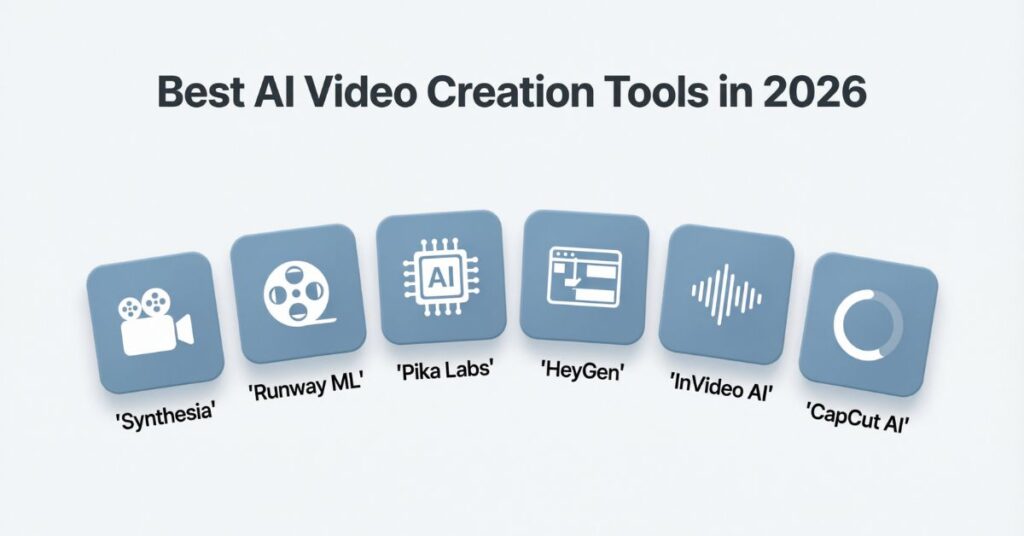
The AI video space is evolving rapidly, with new platforms emerging every year. Below are some of the most powerful and widely used tools available today.
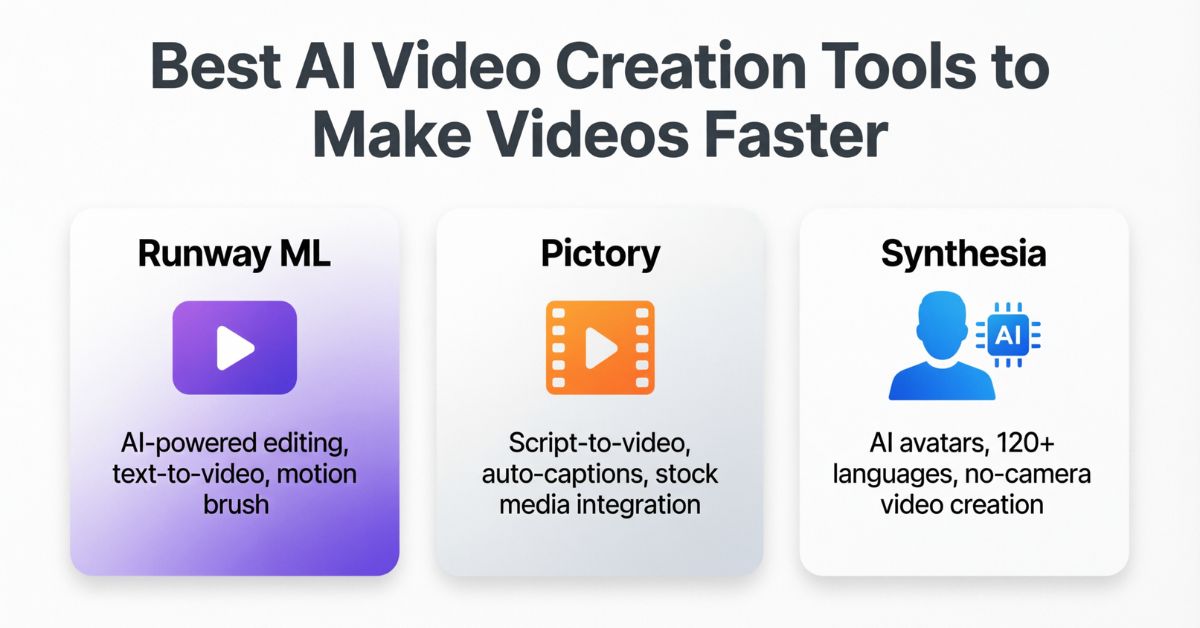
Runway
Runway is one of the most advanced platforms for generative video creation.
Its latest models allow users to generate short video clips from text prompts or reference images. These clips can include realistic motion, camera movements, and visual effects.
Creators often use Runway for
Short cinematic scenes
Experimental storytelling
Visual concept development
AI generated backgrounds and effects
Because it offers powerful editing controls alongside AI generation, Runway has become popular among filmmakers and digital creators.
Synthesia
Synthesia focuses on AI avatar videos.
Instead of recording yourself on camera, you can choose a virtual presenter that reads your script naturally.
This approach is widely used for training materials, internal corporate communication, product demos, and online courses.
AI avatars also support multiple languages, which makes it easier for businesses to produce localized video content for global audiences.
InVideo AI
InVideo AI simplifies video production for marketing and social media.
Users can provide a script or topic, and the platform automatically generates a video complete with visuals, captions, and transitions.
This type of tool is particularly useful for
Faceless YouTube channels
Short form content
Marketing campaigns
Blog to video conversions
Many creators rely on this workflow to transform written content into engaging videos quickly.
DomoAI
DomoAI is known for its creative animation capabilities.
It allows users to transform text, images, or existing footage into stylized animations such as anime, cinematic visuals, or artistic scenes.
Creators often use DomoAI for
Animated storytelling
Artistic video content
Visual experimentation
Social media clips
The ability to convert static images into animated sequences makes it especially useful for creative projects.
Luma Dream Machine
Dream Machine is a text to video model designed to generate realistic motion and cinematic scenes from prompts.
Users can describe a scene, and the system generates a dynamic video sequence based on that description.
Many creators experiment with Dream Machine for concept art, storytelling, and visual ideation.
Because the tool focuses on realism and motion, it has attracted interest from filmmakers and designers.
LTX Studio
LTX Studio focuses on turning scripts into full video sequences.
Instead of generating random clips, the platform helps creators build structured narratives with characters, scenes, and storyboards.
This makes it particularly useful for
Short films
Story driven content
Marketing campaigns
Educational storytelling
The ability to control framing, camera direction, and narrative structure gives creators more creative control over the final video.
How to Choose the Best AI Video Creation Tool
Selecting the best ai video creation tools depends on your goals.
Here are a few factors to consider.
First, think about the type of video you want to create.
If you need educational or business content, avatar based tools may be the best option.
If your focus is storytelling or cinematic visuals, text to video generators may be more suitable.
Second, consider the level of control you want.
Some tools focus on automation and simplicity, while others provide detailed editing controls.
Third, evaluate your workflow.
Creators who produce large volumes of content may prefer tools that support batch creation or automation.
Finally, test different platforms before committing to one.
Each AI tool has its own strengths, and experimentation can help you find the best fit.
Practical Tips for Using AI Video Tools Effectively

Using AI tools effectively requires more than simply entering a prompt.
The quality of your inputs often determines the quality of the output.
Start with clear prompts. Detailed descriptions usually produce better visual results.
Break complex ideas into shorter scenes. Generating multiple small clips often creates smoother storytelling.
Use AI as a creative partner rather than a replacement for creativity. The best results usually come from combining human ideas with AI generation.
Finally, review and refine your videos. Even powerful AI systems benefit from manual editing and adjustments.
The Future of AI Video Creation

AI video generation is advancing rapidly.
Recent developments include models capable of generating high resolution video, realistic physics, and synchronized audio directly from text prompts.
New tools are also integrating scene editing, camera controls, and storytelling features, making AI video creation more accessible to everyday creators.
While the technology is still evolving, it is clear that AI will play an increasingly important role in digital media production.
Conclusion
Video content is becoming essential for communication, marketing, and education.
However, traditional production methods often require significant time and resources.
The best ai video creation tools are changing that reality.
By combining generative AI with automated editing and creative workflows, these platforms allow anyone to create engaging videos with minimal effort.
Whether you are a content creator, marketer, educator, or entrepreneur, AI video tools can help you produce high quality visuals faster than ever before.
As the technology continues to evolve, learning how to use these tools effectively may become one of the most valuable skills in modern digital content creation.